Nina didn’t speak until we’d driven three blocks away from school.
Then she asked a question I wasn’t prepared for.
“Mom, would they have believed me if I’d gotten some answers wrong?”
I pulled into the parking lot of a closed furniture store.
“What?”
“If I hadn’t gotten such a high score.”
Her voice was small.
“Maybe if I’d missed a few questions, he wouldn’t think I cheated.”
I turned toward her.
“Nina, you didn’t do anything wrong by knowing the answers.”
She stared at her hands.
“But he said my score was suspicious.”
“He said your score was high.”
“He said it was too high.”
I wanted to tell her that adults didn’t always understand what children could accomplish.
But that wasn’t quite true.
The adults at her school understood perfectly well. They’d watched her work for months.
Nina had never been the kind of child who finished a worksheet and announced she was brilliant.
She was the child who came home frustrated because she understood nineteen problems but couldn’t figure out the twentieth.
She kept notebooks full of crossed-out calculations. She got excited when she discovered why an answer was wrong.
Last summer, while other kids were spending afternoons at the pool, Nina had carried a notebook to the pool so she could work on it between swimming.
I’d teased her about it.
She’d told me she was having fun.
And I’d believed her.
Now somebody had turned that joy into something suspicious.
“Look at me,” I said.
She did.
“Getting the right answer isn’t something you have to apologize for.”
Her chin trembled.
“What if they take my award away?”
I wanted to promise they wouldn’t.
Instead, I said, “We’re going to find out exactly what’s happening before anybody makes that decision.”
She nodded.
Then she whispered, “Can we go home?”
I called work and told my supervisor I had a family emergency.
When we got home, Nina went straight upstairs.
I found our eight-year-old son, Luke, at the kitchen table with my mother, who had picked him up from school.
He’d made a sign from two sheets of construction paper.
NINA IS #1.
He’d drawn a crooked trophy underneath.
“Can we hang this on the front door?” he asked.
I looked toward the stairs.
“Maybe keep it here for now, buddy.”
He frowned.
“Why?”
“Your sister’s having a hard day.”
“Did somebody die?”
“No.”
“Then why is it a hard day?”
I didn’t have an answer an eight-year-old needed to hear.
That evening, Nina barely touched dinner.
When Luke asked whether she was still getting her trophy, she pushed her chair back.
“I don’t know.”
She went upstairs.
Luke looked at me.
“Did she lose?”
“No, sweetheart.”
“Then why doesn’t anybody know?”
That question stayed with me.
The next morning, I met Nina’s math teacher, Ms. Bennett, before classes started.
She looked exhausted. There were two paper coffee cups on her desk, one empty and one untouched.
“Ruth, I’ve been trying to get permission to talk with you,” she said.
“Then tell me what you can.”
She closed the classroom door.
“The competition organizers contacted the school Sunday evening. They’ve found irregularities involving materials used by some students preparing for the team challenge.”
“What kind of irregularities?”
“Certain solutions in the team round closely match a set of materials that students weren’t authorized to use.”
“Did Nina use them?”
“I don’t know who had access to everything yet.”
I appreciated that she didn’t pretend otherwise.
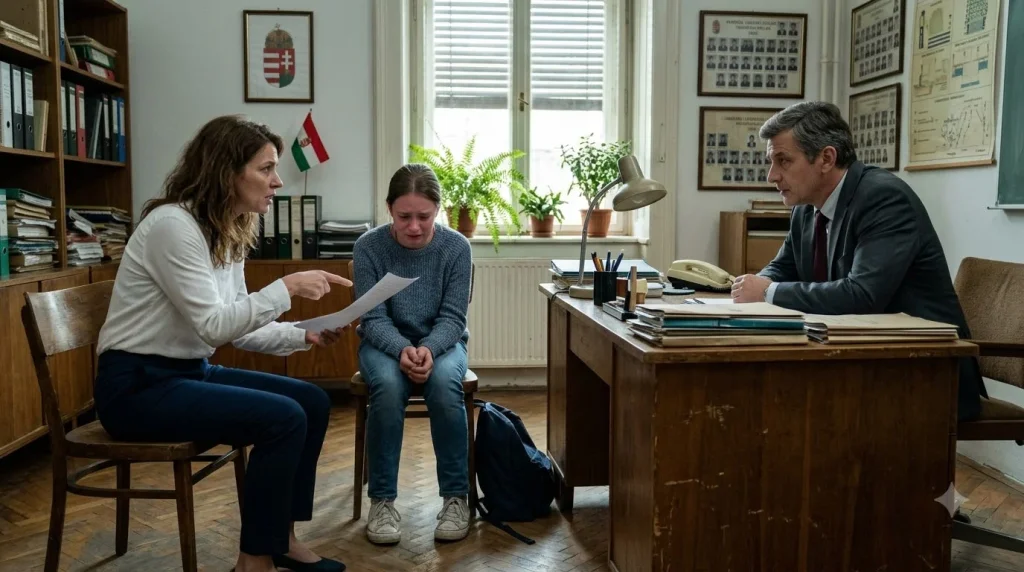
“Then why did Mr. Collins ask her to confess?”
Ms. Bennett’s jaw tightened.
“I didn’t know he’d prepared a statement.”
I showed her the photograph I’d taken of the paper before leaving his office.
She read it.
Her expression changed.
“He used the words ‘individual championship’?”
“Yes.”
“Ruth, the individual competition and the team challenge are scored separately.”
“Explain that to me.”
“The individual round was a supervised written exam. Every student worked independently. Nina’s score came from that exam.”
“And the suspicious answers?”
“They’re from the team challenge.”
I sat back.
“Then Nina’s individual award isn’t being investigated?”
“Not according to the initial notice I received.”
“Does the principal know that?”
“Yes.”
“Then why is he doing this?”
Ms. Bennett looked toward the closed door.
“Our school has never won a state title before. Mr. Collins has spent months promoting the math program. The school board is supposed to recognize the team next week.”
“So?”
“So he’s terrified that if the team is disqualified, everyone will question the individual result too.”
I rubbed my forehead.
“That doesn’t make Nina responsible.”
“No,” she said quietly. “It doesn’t.”
I asked whether she would help us establish what Nina had actually done.
She nodded.
“I can help gather her work and request the proper review. But I won’t pretend the team issue isn’t real.”
“That’s not what I’m asking.”
“Good.”
Popular Posts
→- 1
- 2
- 3
- 4




Recently Viewed
Stories you read recently will appear here.